Why Jewelry Material Determines Healing Success
When you get a new ear, facial, or body piercing, a hollow needle creates a puncture wound. Until your body builds an internal tunnel of mature skin cells (a fistula), that open tissue remains in constant contact with whatever jewelry is placed inside it. Low-grade metals leach trace elements into your bloodstream, causing contact dermatitis, localized inflammation, and chronic irritation bumps that many mistakenly assume are infections. Understanding your metal choices gives your new piercing the best possible foundation.
1. Biocompatible Metals Compared
Here is how the most common body jewelry materials stack up against medical safety guidelines:
| Metal Type | Nickel Content | Weight & Biocompatibility | Suitability for Fresh Piercings |
|---|---|---|---|
| ASTM F-136 Implant-Grade Titanium | 0% (Completely Nickel-Free) | Extremely lightweight, mirror-polished, inert in human tissue | Optimal (Gold Standard) |
| 14K / 18K Solid Gold | Nickel-free alloys only | Rich luster, biocompatible when free of nickel and cadmium | Excellent (Solid only, never plated) |
| Niobium | 0% (Pure elemental metal) | Slightly heavier than titanium, highly inert, hypoallergenic | Excellent for sensitive clients |
| "Surgical" Steel (316L) | Contains 8% – 12% Nickel | Durable and inexpensive, but nickel frequently leaches into healing skin | Use with caution (Healed only) |
| Silver / Gold Plated / Brass | High nickel and copper content | Tarnishes, oxidizes black in wet wounds, causes toxic staining | Never for fresh piercings |
2. The Truth About "Surgical Steel" (316L)
The term "surgical steel" is widely misunderstood. Many assume it means "medical grade," but in reality, commercial 316L surgical stainless steel contains anywhere from 8% to 12% nickel—the leading cause of contact metal allergies globally. While surgical steel is safe for scalpels and surgical instruments that only touch the body for minutes at a time, leaving it inside a wet, healing wound for months can trigger itchy, weeping redness, swelling, and permanent scarring. That is why reputable modern piercing studios exclusively recommend implant-grade ASTM F-136 titanium for fresh wounds.
3. Threading Technology: Threadless vs. Internally vs. Externally Threaded
How the decorative top attaches to the post is just as important as the metal itself. There are three mechanical designs:
Threadless (Push-Pin)
The modern industry favorite. The decorative top has a subtle bent pin that slides snugly into a hollow post. Zero threads means zero chance of skin snagging, loosening during sleep, or stripped screws. Incredibly secure and effortless to swap styles.
Internally Threaded
The screw threads are machined onto the decorative top ball, while the post itself is completely smooth with a hollow tapped hole. When inserted through your skin, only polished, smooth metal touches your tissue.
Externally Threaded (Avoid!)
The post has sharp, jagged ridges exposed on the outside. As the barbell is pulled or pushed through your sensitive wound, those serrated metal threads scrape, tear, and lacerate your healing fistula like miniature saws.
4. Why Flatback Labrets Beat Butterfly Backs Every Time
Traditional ear studs with butterfly clasps were designed for gun piercings decades ago. They are notorious for two severe flaws:
In contrast, Flatback Labret posts rest smooth and flush against the back of your ear or inner lip, preventing hair tangles, eliminating poke-pain when sleeping, and allowing gentle saline rinses to flush clean effortlessly.
5. The Vital Step: Post Downsizing at 4 to 6 Weeks
When your piercer initially fits your jewelry, they intentionally select a post that is 1mm to 2mm longer than your resting tissue. This extra room gives your ear or face space to expand during the normal inflammatory swelling phase without cutting into your skin. However, once the swelling subsides (usually by weeks 4 to 6), that extra length becomes hazardous:
- • A long bar tilts whenever you lie on your pillow, causing the piercing angle to migrate crookedly.
- • Long bars snag on clothes, towels, and hair brushes, causing irritation bumps.
- • Returning to Remy Studio for a quick downsize replaces the temporary longer post with a flush, custom-fitted post while keeping your original decorative gem.
Curated Luxury Piercing Jewelry at Remy Tattoo Studio
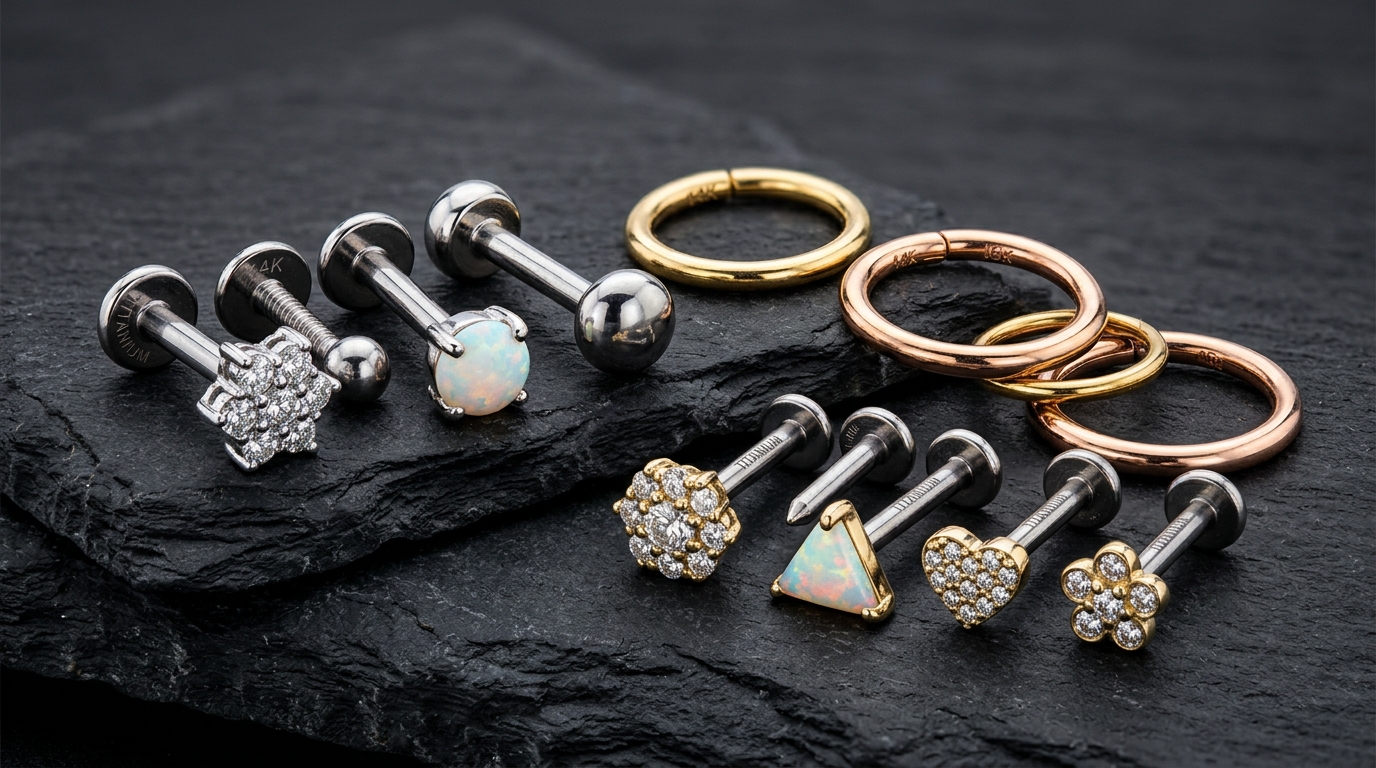
At Remy Tattoo Studio in Nagercoil, we believe your piercing deserves heirloom-quality materials. We carry an extensive catalog of verified implant-grade ASTM F-136 titanium, authentic Swarovski cubic zirconias, synthetic opals, and solid 14k gold ends. Every piece is mirror-polished, pre-sterilized via clinical autoclaves, and fitted with precision to suit your individual ear, facial, or body anatomy.